
National Security Notebook | Number 15, June 30, 2026
In Europe’s east, the bear is at the door.

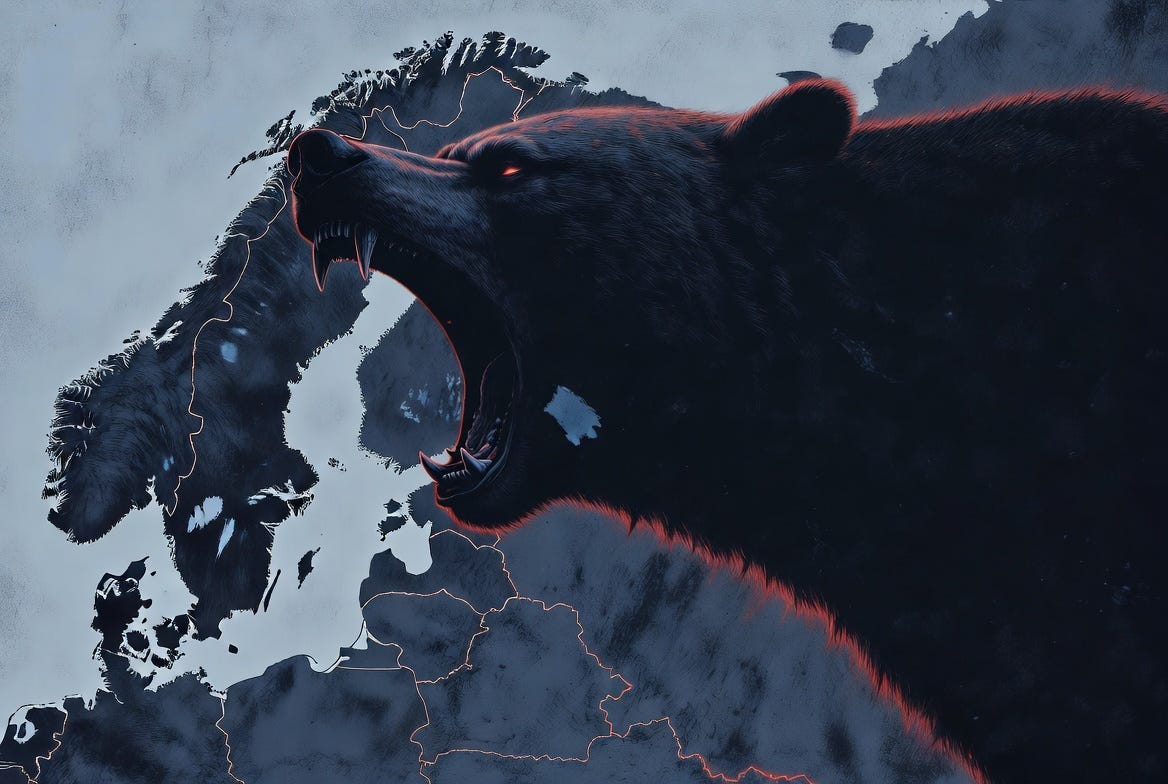
When I was traveling across Europe earlier this month, I found myself struck anew by the rhetorical mismatch regarding Russia that still persists across the continent. To be sure, support for Ukraine, and opposition to Vladimir Putin’s war of aggression against it, remains a broad constant in most places. Still, the threat posed by Moscow’s imperial ambitions in many ways remains an abstract concept for “Old Europe” – where there’s a great deal of general talk about the need for stepped-up defense spending to deal with the Russian threat, but far less concrete understanding of what the alternative might mean.
That’s decidedly not the case on NATO’s eastern flank. Just listen to Pawel Zlota. In a recent interview, Poland’s intelligence chief warned that the danger was both real and growing, and that his country needs to operate as if conflict with the Kremlin is a “near term prospect.”
“Today, taking into account the full spectrum of threats from the Kremlin, we must shape our mindset accordingly and in our day-to-day operations act as if an armed conflict with Russia were a near-term prospect,” Zlota, who heads Poland’s Foreign Intelligence Agency, known as the AW, told the Rzeczpospolita daily. “The level of Russian aggression is very high, and the risk of military confrontation is real.”
Zlota’s views are increasingly shared across Eastern Europe, where countries simply don’t have the luxury of distance from Putin’s predatory regime, the way states like France and Spain do. That’s why the three Baltic countries (Estonia, Latvia and Lithuania) are jointly investing in a “Baltic Defense Line” consisting of some 600 concrete bunkers – which, presumably, will provide emplaced local forces cover to fend off invading Russian troops. It’s why Estonia is training students to use drones; Sweden is fielding a “total defence” doctrine that includes mass emergency preparedness; and Finland has fielded a high-tech barrier (complete with fencing, cameras and sensors) along its 830-mile border with Russia. Regional governments have even put together a cooperative evacuation plan if they turn out to be unable to hold the line against Russian aggression, when it comes.
The responses may vary, in other words, but the sense of danger is very clearly shared. It’s driven by Moscow’s consistent imperial drive, the country’s growing militarization, and statements from leading officials that make clear that Russia’s ambitions extend far beyond Ukraine. So, like Poland, Eastern European governments are increasingly of the mind that what is happening in Ukraine today could happen to them tomorrow – particularly if the West doesn’t manage to sufficiently deter Russia from its current, revisionist course.