
National Security Notebook | Number 8, May 14, 2026
The PRC tries to get smarter on the Mideast.

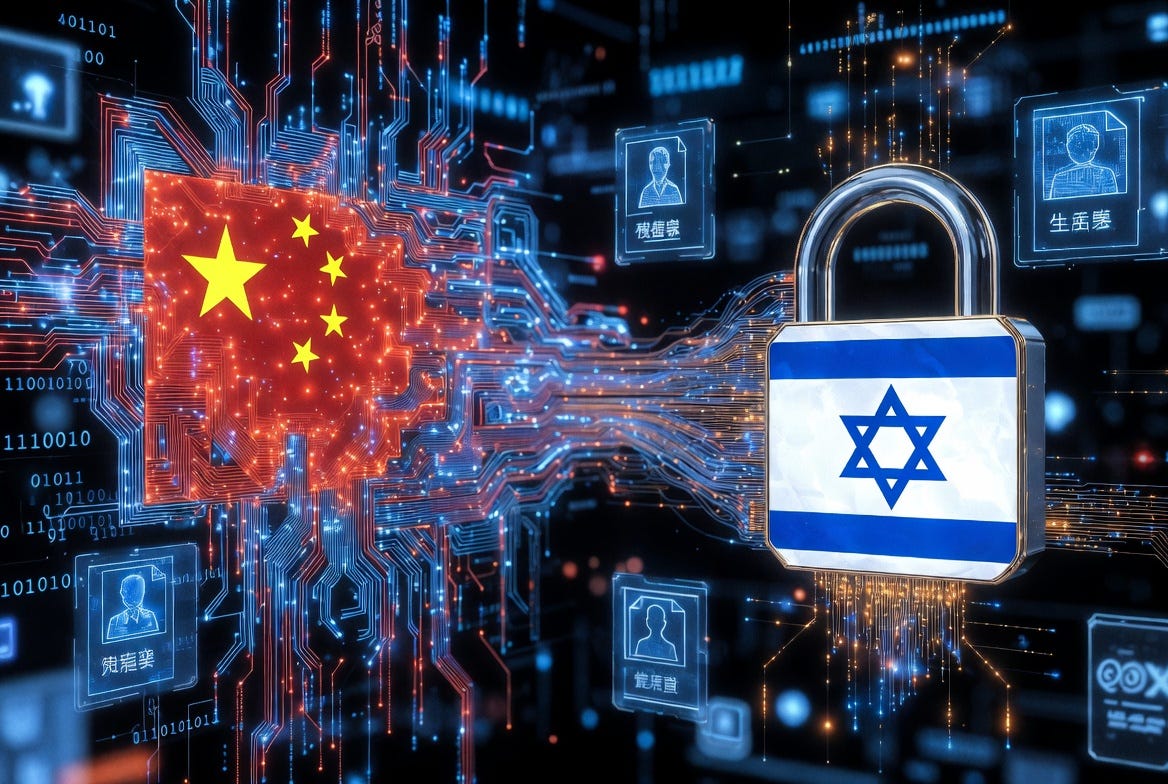
Most of the time, when we think about China, we envision a consolidated one-party state with almost unlimited informational awareness. Every once in a while, though, we catch a glimpse of the fact that policymakers in Beijing are searching for answers just like everyone else.
The Middle East offers a case in point. Over on his Memetic Warfare Substack this week, my friend Ari Ben Am highlights a new Chinese virtual espionage campaign to, among other things, recruit “diplomacy researchers” on Israeli policy. Ari did a bit of digging, and he makes a convincing case that this represents a sophisticated – or perhaps not-so-sophisticated – effort by the PRC to get smart on topics (like Israel and other Middle Eastern states) that lie outside of its main collection focus.
There are a couple of reasons for that, and they’re worth getting into in a bit more detail.
The first is the current state of the Sino-Israeli relationship. A dozen years ago, ties between Beijing and Jerusalem were in full bloom. Drawn by the dynamism of Israel’s high-tech sector, China had become the second largest national investor in the Jewish state, after the U.S. Thereafter, though, American concerns over the national security implications of those burgeoning ties served to chill the relationship, at least somewhat. (I wrote about those tensions at the time for both the Wall Street Journal and the National Institute for Public Policy.)
But it was Beijing’s anti-Israel turn after October 7, 2023 that really hammered home to Israeli policymakers the “new normal” – in which China didn’t just abet anti-Israel and anti-Semitic rhetoric, but helped to amplify it via social media platforms like TikTok. For Israel, the writing was very much on the wall. As one official there told me a few months ago, when it comes to China “the honeymoon is well and truly over.” And without its previous, preferential access, Beijing is forced to get its insights into Israeli thinking the way other countries do – by pilfering it.
The second is the current state of Israeli strategy vis-à-vis Iran. Prime Minister Netanyahu has refrained from saying so publicly, but Israel is none too pleased with the current status of the Iran “file” – and for good reason. The threats from Iran’s nuclear and ballistic missile programs have not been neutralized, while the Trump administration’s fragile ceasefire with Tehran has extended to Israel’s north, with Jerusalem coming under pressure from the White House not to act against Hezbollah in Lebanon.
Then there’s the question of a potential U.S.-Iranian deal. Israel is apparently worried that Trump might end up striking a bad bargain with Iran that locks in Iranian strategic capabilities while significantly complicating future Israeli actions against them. With national elections coming up this Fall, all this amounts to significantly less than Prime Minister Netanyahu, a perennial contender for political office, was hoping to be able to run on.
That, in turn, suggests Israel might try and adopt a more independent stance on Iran – something Netanyahu himself intimated at in his recent 60 Minutes interview, when he noted that the Iran war was “not over.” That’s significant for the PRC, since the Iranian regime was and remains a generally useful strategic partner. As such, China understandably wants to know precisely how much danger the Iranian regime is truly in.
Part of that answer will be divulged, presumably, during the Trump-Xi summit that’s taking place in Beijing at the moment. China is clearly hoping to glean the rest of the answer another way.